
File scopes
Files are organized into three scopes:Browsing files
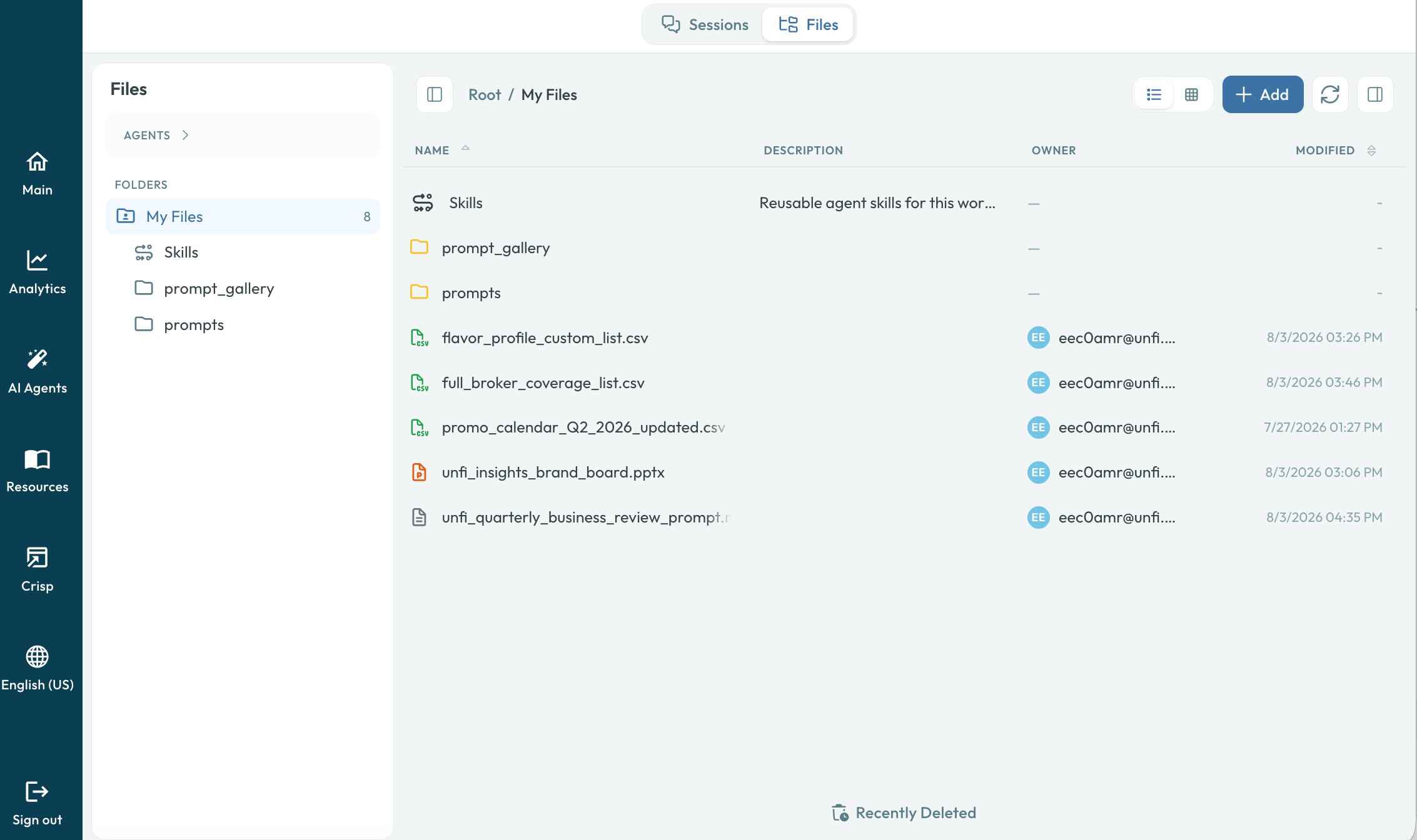
The file explorer has three panels:- Folder tree (left) — Navigate the directory structure. On mobile this slides in from the left edge.
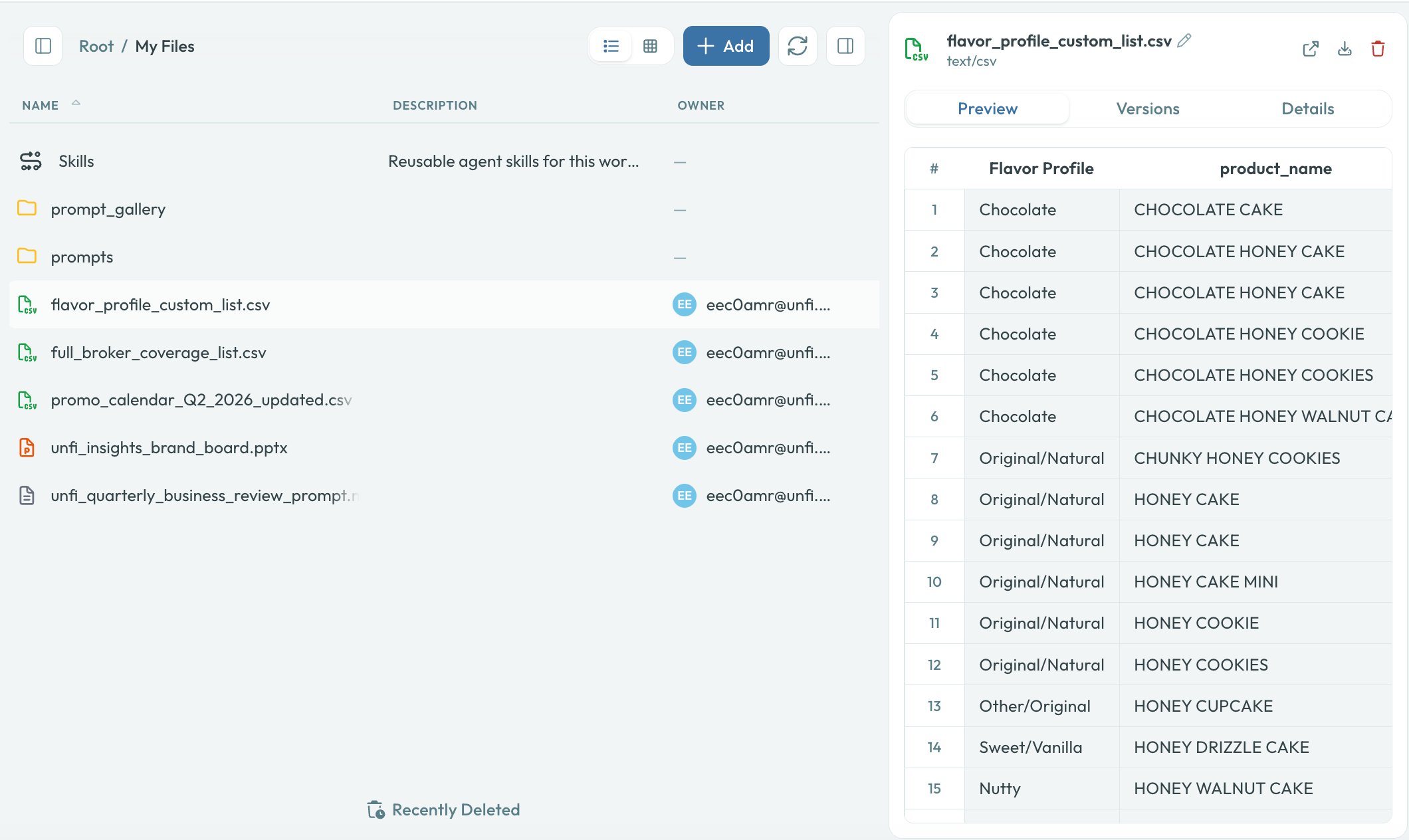
- File list (center) — Shows files in the selected folder, including an Owner column for shared items. Click a file to preview it. The preview refreshes automatically when the file is saved.
- File info (right) — Displays metadata, a preview, and version history for the selected file. On mobile this slides in from the right edge.
Keyboard shortcuts
Context menu
Right-click (or long-press on mobile) any file or folder for an actions menu with Edit, Download, Copy file path, Share, Upload, Rename, Copy to folder, and Delete. Deleting a folder correctly removes it from the tree sidebar. Copy file path copies the file’s VFS path (for example,/mnt/shared/reports/q4-summary.md) to your clipboard, so you can paste it directly into a skill, a persona’s agent statement, or a chat message. A toast confirms the copy.
Recently Deleted
If you delete a file or folder from My Files and need it back, open Recently Deleted from the file explorer toolbar. The view lists items deleted from the folder you’re currently viewing and lets you restore them in place.1
Open the folder the item was deleted from
Recently Deleted is scoped to your current location. The dialog header shows the folder path (for example,
My Files / reports) so you know which trash you’re looking at.2
Click Recently Deleted in the toolbar
A dialog opens with deleted files and folders, when they were removed, and their size.
3
Click Restore
The item is restored to its original path. Folders restore the full nested tree. If a file already exists at the original path, the restore is skipped so it does not overwrite current content.
Recently Deleted is only available for My Files. It does not apply to Session files.
Uploading files
You can upload files in several ways:- Drag and drop onto the file list.
- Click Upload in the toolbar.
- In chat, click the paperclip icon next to the message input and pick Upload file.
.doc, .docx, .docm, .odt, .rtf), spreadsheets (.xls, .xlsx, .xlsm, .ods, CSV, TSV), presentations (.ppt, .pptx, .pptm, .odp), images (PNG, JPEG, WebP, GIF, SVG), text and markdown (.txt, .md, .mdx, .log), data and config files (JSON, JSON Lines, YAML, XML, TOML, .env), and common source code (Python, JavaScript/TypeScript, SQL, HTML/CSS, shell, Ruby, Java, C/C++, Go, Rust, PHP). See Supported file formats for the full list.
Copy and overwrite
When you copy a file into a folder that already has a file with the same name, a confirmation dialog asks whether to overwrite. Long file names wrap neatly in the warning text.Creating folders
Click New Folder in the toolbar to create a folder inside the current directory. Drag files between folders to reorganize.File previews
- Markdown — Opens in Preview by default with full formatting, including LaTeX math, VFS links, file cards, and inline images. YAML front matter is stripped before preview. Switch to Edit in the toolbar to modify the source; a dirty indicator appears until you save.
- CSV — Opens with a Table / Text toggle in the toolbar. Table is an in-cell spreadsheet: edit a cell, then use the hover controls on any row or column to add or delete it. Text shows the raw source. Table is read-only past 100 rows; use Text or download the file for the full dataset.
- Code and text files — Syntax-highlighted for JSON, Python, TypeScript, SQL, XML, CSS, Markdown, YAML, and more, centered in the preview pane.
- Images — Displayed at native size, with no upscaling and no checkerboard background.
- PDF — Rendered in-browser.
- Large files (over 100 KB) — Opened in a read-only preview with a truncation notice.
- Binary files (video, zip, and other unpreviewable formats) — Show a download prompt instead of an empty preview.
Version history
Each file tracks its version history. Open the file info panel and scroll to Versions to see when the file was created or modified, and by whom.Reverting to a previous version
From the Versions list, click Revert on any past version. A confirmation dialog asks you to confirm; after accepting, the file contents are restored to that version and a new version entry is added.Editing files
Open a file and use the toolbar to edit it. Markdown files switch between Preview and Edit; CSVs switch between Table and Text and let you edit cells directly. Code and text files open in the built-in editor with syntax highlighting. Press⌘Enter / Ctrl+Enter to save and close.
AI-assisted markdown editing
For markdown files, click Edit with AI in the toolbar to open a chat-based editing interface. Describe the changes you want in natural language and the agent applies them. A track-changes preview highlights exactly what was added, modified, or removed with color-coded diffs before you accept. The track-changes view uses theme-aware colors so it stays legible in dark mode. You can start an Edit with AI session directly from the Files page without opening a chat first. The refine runs against the file you have open.Agent-driven file editing
Agents can read, search, edit, and compare files during a conversation:
Moves and copies follow the same rules as file explorer actions: agents can write into My Files, Shared, the active Session, and Local folder mounts, but not into read-only OneDrive, SharePoint, or Google Drive mounts. Folders are not supported — agents move or copy one file at a time.
When an agent edits a file, the chat shows an inline diff card with syntax-colored added/removed lines, the file icon, and a link to open the full file.
@ file mentions in chat
You can reference any file in a chat message by typing@ in the message input.
1
Type @
After a space or at the beginning of a line, type the
@ character. A dropdown appears.2
Search for a file
Start typing the file name. The dropdown uses fuzzy search across My Files, Shared, and Session files, and prioritizes recent and relevant matches. Files with auto-generated UUID/GUID names are hidden to keep the list readable.
3
Select a file
Click the file or press Enter. The file’s VFS reference is inserted into your message and rendered as a clickable pill.
4
Send your message
The agent receives the file reference and can read, analyze, edit, or transform the file as part of its response.
@ dropdown never clips the first row when the list is taller than the viewport, and its rendering is optimized so the list stays smooth even with hundreds of files.
File references in agent responses
When an agent creates or references a file, the path appears as a clickable link or a file card in the chat. Clicking it opens the file in the file explorer. Agents use the same VFS path format (/mnt/current_session/chart.svg, /mnt/shared/report.csv) so you always know where a file lives.